START-UP BUSINESS CONSULTING
Employee Performance
Strategic Thinking
Cost Leadership
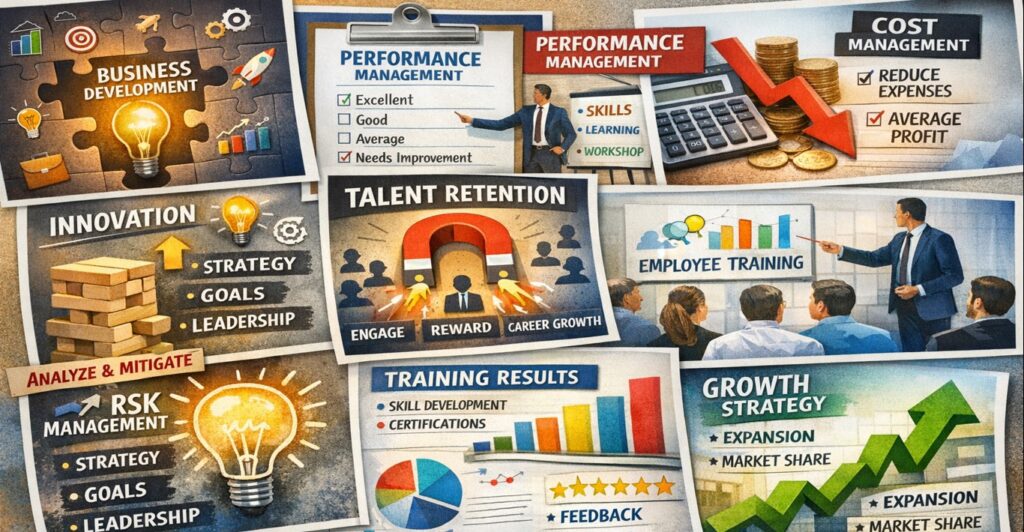
With India moving towards massive economic growth, we see a huge spurt in start-ups. We help these start-ups find their feet and guide them in developing a workplace culture and processes as well as business strategy. This includes retention of talent strategy and employee performance management.
We believe in our mission to curate ‘happy workplaces beaming with business’ !!
In the domain of cost leadership, we help senior management understand the importance of common sense in vigilant audit in business practices through Kaizen and 5S. We help start-ups develop robust KRA and KPI tracking structures linking them with fair and transparent appraisals and resultant R&R outcomes for the workforce. This also includes training and coaching top leadership and following what we call the ‘navratna leadership’ model in the implementing of this process. These are important to create a culture of a genuine work-life balance.
We also help organisations develop maximum ROI out of their training interventions through a process called L&D Implementation System through uniquely designed tracking process of the learning outcomes while integrating them with the KRA’s.
One on one coaching services for such implementation are also delivered for organisational growth and development to senior leaders including CEO’s and other C-suite managers on business development, leadership and strategic thinking.
COST LEADERSHIP – COMPETETIVE ADVANTAGE
A business profit is centred broadly around two facets– revenue and cost. In a highly competitive market, usually there is a cap on how much profits revenue can bring. Smart organisations therefore focus on creating a cost management advantage to increase margins and become a cost leader. If we see it minutely this is not very difficult. This is simply common sense at the workplace.
Premise for cost management
As per research, 95% of organisational activities fall under the domain of TIMMWOOLDA which are essentially grouped under Kaizen wastes or non value added activities. Non value added activities are those activities done by us for which clients do not pay us anything. Hence there is some introspection required on what these are what is the value they add in the process if any. Revenue falls in the domain of sales. Almost rest all are cost heads.
Therefore, an alert management can alter, improvise or eliminate these unproductive activities to save massive costs. The most common examples are D-Mart, Maruti, Blinkit/ Zomato, Paytm, Flipkart, Indigo Airlines and many more.
Examples of TIMWWOOLDA wastes in daily work
- Unnecessary delays due to a long process of approvals by multiple managers
- Office filled with material not needed since a very long time covering unnecessary space leading to seating space and movement issues and more
- Files and important documents not found in time due to inefficient storage
- Stationery and other office material not tracked properly leading to thefts and/ or careless handling
- No SOP for reporting, attendance and dress code of employees
- Cluttered and disorganised storage of files and folders in desktops plus careless email management
- Over stocking of goods like paper rims, water bottles
- Poorly designed office leading to unnecessary movement of employees
- Less trained leaders and staff leading to defects and delays at work without accountability
- No accounting of expenditures leading to unchecked spending in the name of work
Areas of improvement
Some of the areas that come in sight to start with the practise of reducing Kaizen wastes as as under:
- Create an awareness drive for cost leakages and using common business sense among employees at all level
- Curate robust SOP mechanism in place
- Train organisations on being mindful of their surroundings and conduct GEMBA walks
- Ensure that processes like poka yoke are applied to avoid errors rather than wasting time, effort and resources on treatment later.
- Employees at all levels of hierarchy, following a top-down approach are supposed to give ideas in a very scientific process in the development of the organisation and especially reducing Kaizen wastes. This scientific process can be called – Idea Factory.
To attain cost leadership almost 95% of these non-value added activities must be brought under a scanner. A huge amount of cost can be saved by the organisation which can be used to fight heavy competition outside and office and employee welfare including R&D and innovative ways of work, inside.
Office Kaizen when integrated with 5S, helps clear most of the non-value added activities for which the client does not pay us. This helps us reduce our unwarranted expenses and increase our profit margins and also helps create a positive environment for our employees.
How do Office Kaizen and 5S help
Office Kaizen is a cost saving model used globally in various organisations. It is known for reducing multiple wastes at factories and also the ‘white collared’ offices including banks, IT companies, educational institutions and any other industry. It helps in making the processes leaner, efficient and more productive.
Kaizen and 5S are known for their cost saving methodologies better known as lean management tools. In implementing Office Kaizen, 5S way of working is very helpful. Kaizen means Small and Continuous improvements for better. Organisations need to focus how they can improve every day with anything that increases revenue and decreases costs.
Let us understand what 5S is and how it works.
- Sort – Acts as a cleaning agent by identifying wastes and differentiating value added and non-value added activities and material
- Set in Order – It helps organise work practices and material properly. This is the most critical part where most wastes are eliminated
- Shine – Clean and tidy area which looks very organised and renewed for Kanban display
- Standardise – Define clear SOPs for the work order and set a tone of work for the future
- Sustain – To define clear audit and review policies to ensure SOPs are implemented and work order is maintained
5S in addition to more benefits helps bring a definite process structure in work which helps keep Kaizen wastes at bay and enhance process efficiency and employee happiness.
To conclude
Cost leadership has given quite a leading edge to companies. Fostering a culture of problem solving and training of leaders (to conduct GEMBA walks and audits) and other employees, engaging employees at all levels to come up with innovative ideas in their work domain are the most common practices used by cost leaders in the success of Office Kaizen implementation.
To smoothen the process and implement SOP based work, intention and conviction of the management is required to equip the talented workforce to implement 5S methods of work to enhance efficiency in every minute of their work.
Finally, respective managers need to be trained to conduct Kaizen and 5S audits to ensure the smooth functioning and execution of this process which is nothing but common business sense.
To inspire and retain talent in the company, it is essential that employers take care that the performance of the employees is tracked and measured accurately and fairly.
Utmost transparency and a lean and direct communication channel is critical for employees to happily want to come to the workplace.
Proper acknowledgment of good work through recognition and rewards goes a long way to create a feeling of loyalty which spirals within the system.
To achieve this purpose, we create a robust system of performance management. The process flows through the following steps:
- Employee Key Result Areas are defined and integrated with their Job Description (JD)
- Due weightage is alloted to the respective categories in the list of KRA’s
- Goals to be divided in three parameters – JD, Leadership skills and Behavioural parameters
- Skill level is assessed for all KRA’s
- Training needs identified through this process and a updated in the training calendar and tracked religiously
- Goals to be defined and their achievement journey is specifically and SMARTly measured and supported as and when needed
- Key Performance Indicators (KPI’s) allotted therefore to the employee
- KPI’s finally linked with the appraisal structure
Due training is provided to the stakeholders for the smooth implementation of the whole process.
Globally it is believed that we cannot measure the ROI given by a training intervention. This is true and that is the reason many organisations do not want to spend their time, money and effort into training and believe in the on-the-job training method of enabling their employees to learn. But this might take time and is not found to be the most dependable method to train employees on their work or behavioural needs.
We have created a simple yet scientific method to measure the impact of the training in employee behaviour and performance and see if intangibly we can ensure some positive and measurable impact post training.
Training calendars are created post survey from employee periodically so as to Identify the Training Needs (TNI)
An inhouse Training Academy is created
- Which conducts all training
- Certifies employees for trainings
- Reviews and evaluates employees on skills, knowledge and behavioural attitude by exams conducted periodically and scores recorded
- Conducts orientation programme for newly joined employees
A thoroughly conducted book review session
An e-library, shared with every employee
Employee health and mental wellness programmed are conducted periodically
- Trainings required by government regulations like POSH, Listed company regulations including ESG, basics of AI inclusion and more are conducted for respective employees
- Organisational and functional SWOT exercise
The academy is run by the Human Resource (HR) department and the functioned in consultation with the respective functional heads and managers as the need may be and due certifications, awards and felicitations (as part of R&R) are also given as and when due.